Where company know-how becomes working software.

An AI analyst interviews your people and builds a living model of your company, ready for the AI agents and apps you build on it.

Book a demo

From how it works today to software in use.

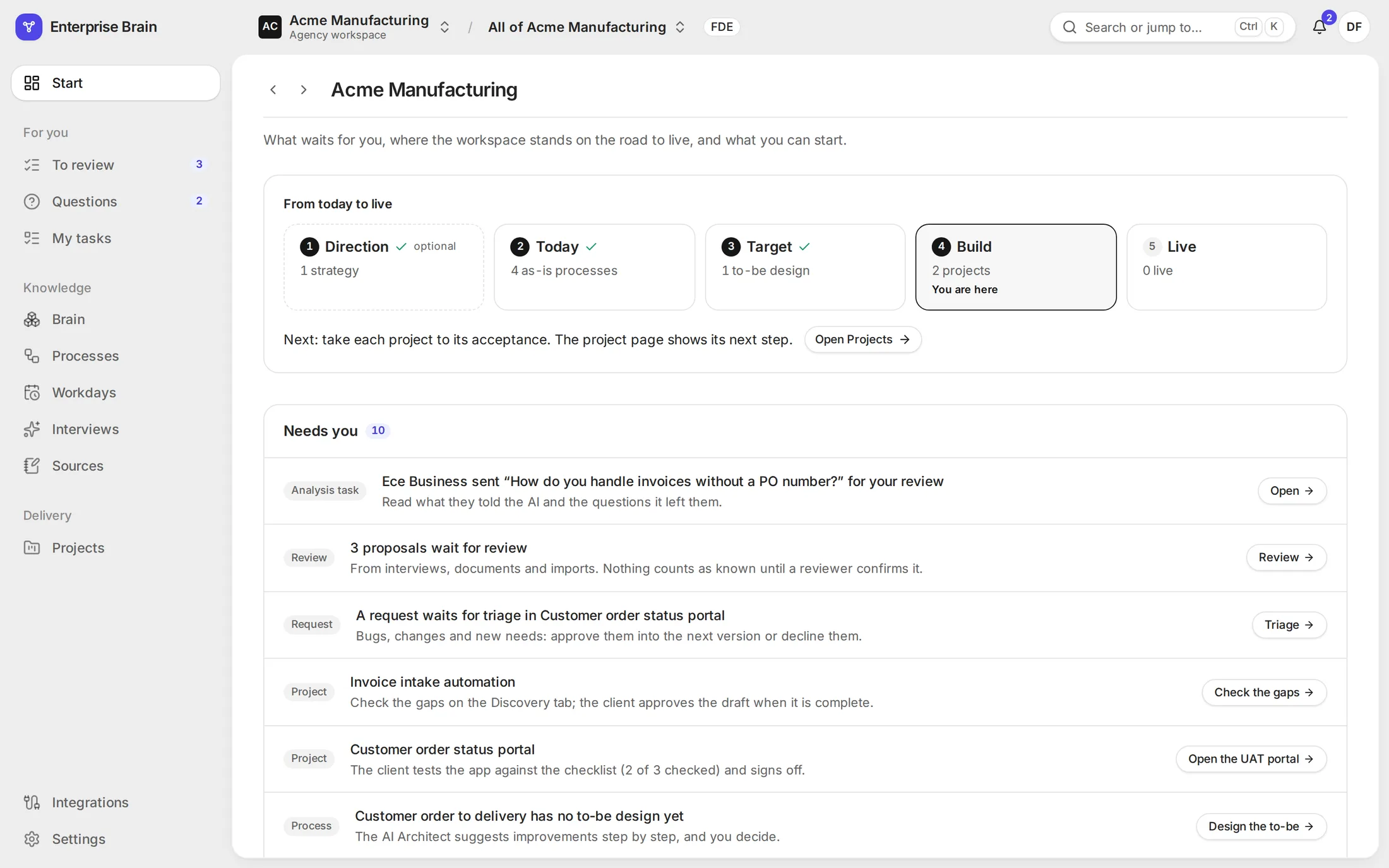
Every process and project walks the same road. Enterprise Brain shows where each one stands and what comes next.

  1. DirectionThe strategy every design answers to
  2. TodayHow the work is done now, with its numbers
  3. TargetThe better process, designed step by step
  4. BuildA spec and context package for Claude Code
  5. LiveTested and signed off by the client
The Start page of the Acme demo workspace: the road from today to live with the workspace at Build, and what needs the person signed in.
Start, in the Acme demo workspace: where the company stands on its road, and what waits for you.

An analyst that interviews like a senior one.

It reads the Brain first, asks one thing at a time with a suggested answer, notes the numbers and raises what contradicts the Brain. What it learns waits for review.

  1. Analyst AI

    The Brain says Finance approves supplier invoices in SAP S/4HANA, and the rule CFO approval above 10,000 EUR applies. Is that how it works for invoices without a PO number?

    Suggested answerYes, the same approval applies
  2. Ece Finance clerk

    Mostly. Without a PO I first ask Procurement for one, which takes a day or two. And we accept up to a 2% difference against the PO price.

  3. Analyst AI

    Thank you. About how many of the 1,200 invoices a month arrive without a PO?

  4. Ece Finance clerk

    Around 150.

Proposed to the Brainfrom this interview
  • RuleThree-way match tolerance 2%Proposed
  • Process stepAsk Procurement for the missing PO, waits 1 to 2 daysProposed
  • Volume150 of 1,200 invoices a month arrive without a POProposed
  • Open questionWho approves invoices when the CFO is away?Proposed

Nothing counts as known until a reviewer confirms it.

An interview about the Acme demo's supplier invoices. The Analyst speaks the interviewee's language, Turkish or English.

One brain for the whole company.

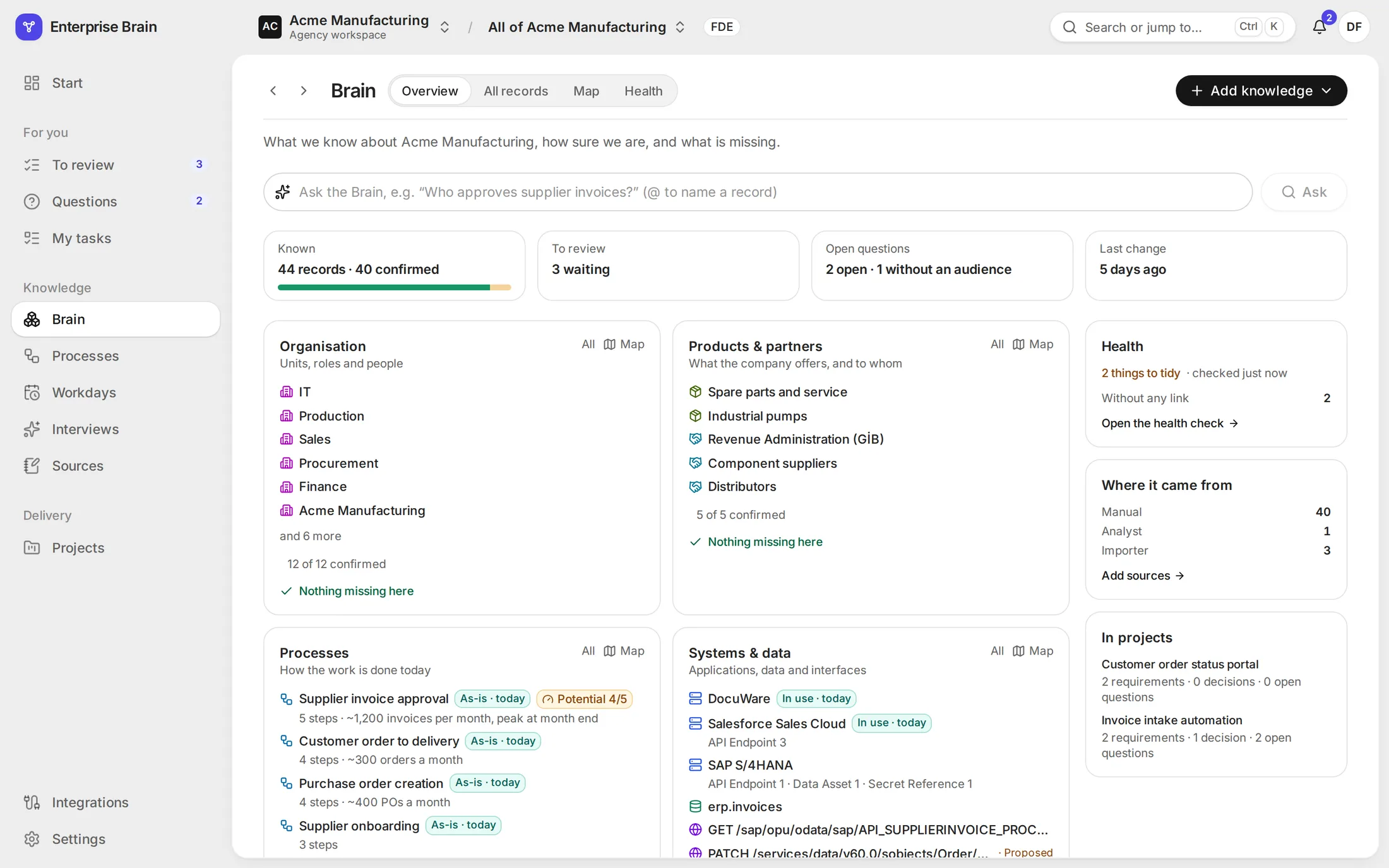
Systems, data, processes, rules, people and decisions as linked records. Each says where it came from and who confirmed it, and every project draws on the same Brain.

owned bypart ofusespart of
ProcessAs-isSupplier invoice approval
DepartmentFinance
RoleFinance clerk
Tableerp.invoices
SystemSAP S/4HANA
RuleCFO approval above 10,000 EUR
BenefitLess manual invoice entry
RuleThree-way match tolerance 2%
Proposed by the AnalystConfirmed by the steward
Records from the Acme demo workspace. The Analyst proposes a rule it heard in an interview; a steward confirms it.
The Brain overview of the Acme demo: 44 records with 40 confirmed, what is known per area (organisation, products and partners, processes, systems and data), its health and where the knowledge came from.
The Brain overview: what is known per area, how sure it is, and what is still missing.

Every workflow. A visible outcome.

The AI Architect designs the target with the people who do the work, step by step. The platform shows what it saves in hours, people and money.

As-is · todaySupplier invoice approval
  1. Clerk enters invoice in SAPFinance clerk1,440 h
  2. 3-way match with PO and goods receiptFinance clerk960 h
  3. CFO approval above 10,000 EURCFO108 h
  4. Post and schedule paymentFinance clerk480 h
Hours a year, from 1,200 invoices a month≈ 2,988 h
To-be · targetSupplier invoice approval
  1. Invoice agent reads the invoice and pre-fills SAPAI agentAdded0 h
  2. Automatic 3-way matchSAP S/4HANAAutomated0 h
  3. Clerk resolves mismatchesFinance clerkAdded384 h
  4. CFO approval above 10,000 EURCFOKept108 h
  5. Post and schedule paymentSAP S/4HANAAutomated0 h
Hours a year, from 1,200 invoices a month≈ 492 h
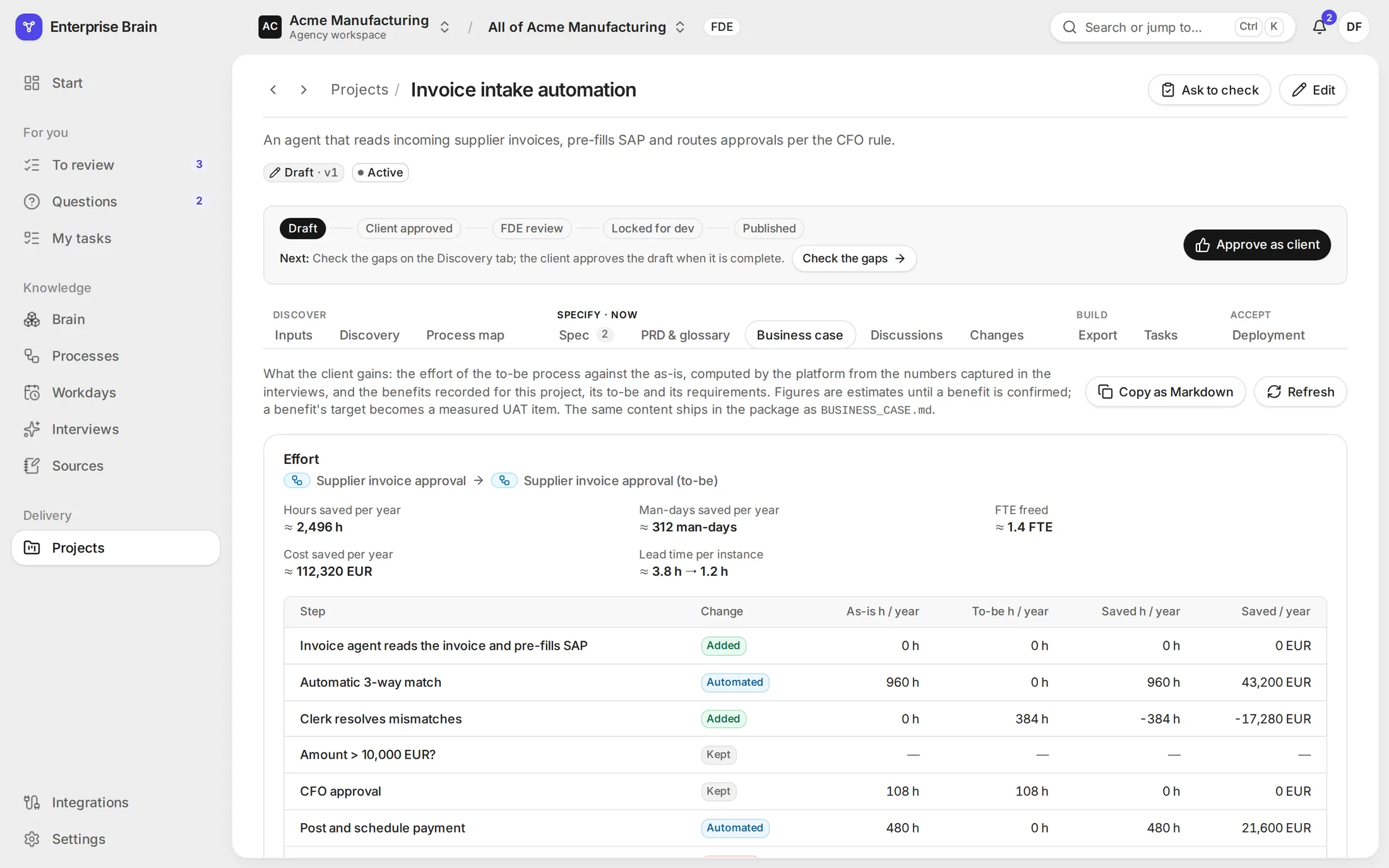
  • ≈ 2,496 hsaved a year
  • ≈ 1.4 FTEfreed
  • ≈ 112,320 EURa year, at the demo’s rate card
  • 3.8 h → 1.2 hlead time per invoice
The Acme demo's supplier invoices. People give the minutes and volumes; the platform does the arithmetic. The AI never computes money.
The business case of the Acme demo's invoice intake project: about 2,496 hours saved a year, 312 man-days, 1.4 FTE freed, 112,320 EUR saved a year and lead time from 3.8 to 1.2 hours, with the saving per step.
The business case of a project: the as-is against the to-be, per step. It ships with the package as BUSINESS_CASE.md.

A spec engineers can trust.

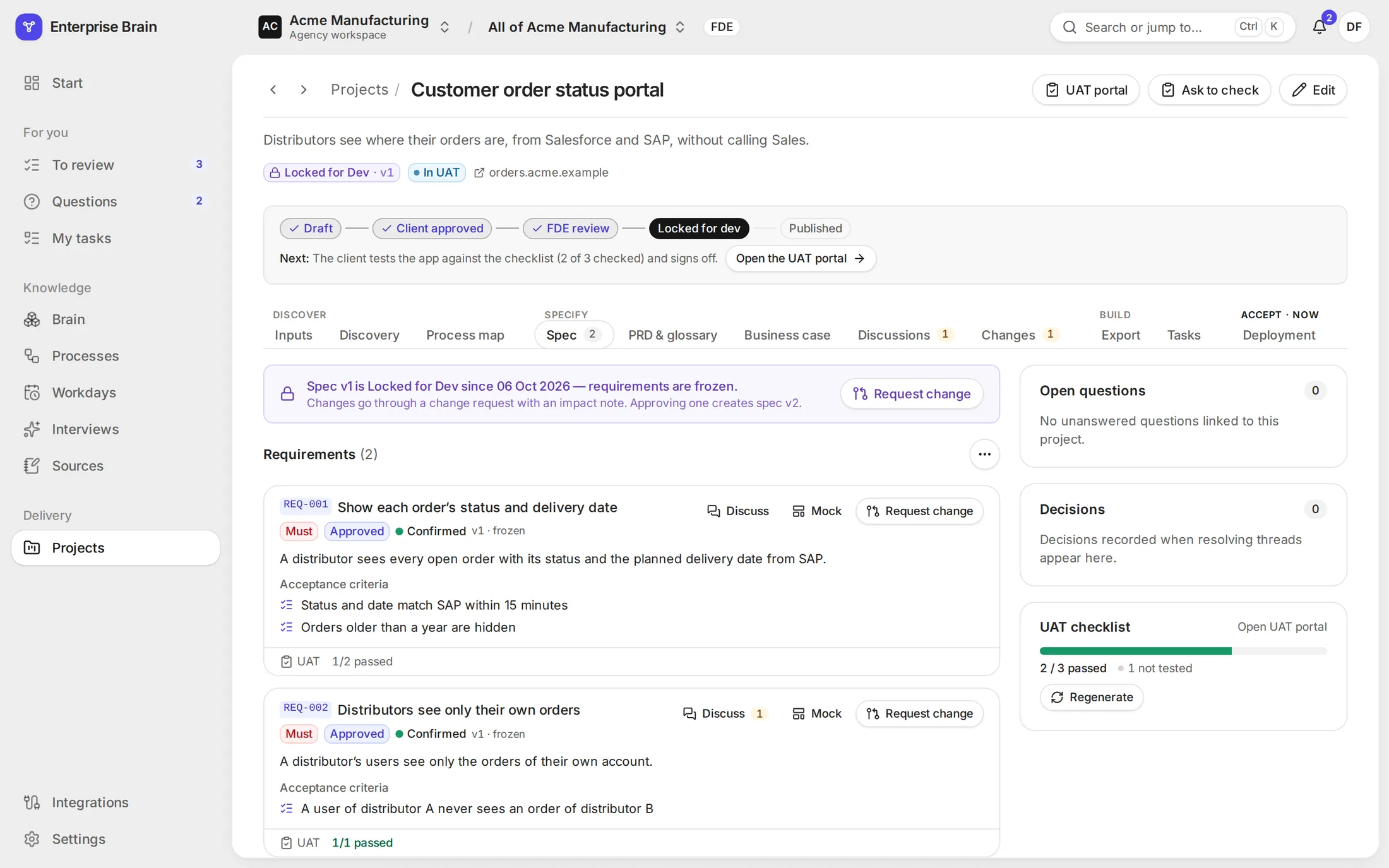
Requirements are records with acceptance criteria. The client approves, a forward-deployed engineer reviews and locks the version, and every question is discussed on the requirement it concerns.

Customer order status portalSpec v1
  1. Draft
  2. Client approved
  3. FDE review
  4. Locked for dev
  5. Published
REQ-002Distributors see only their own orders

Acceptance: a user of distributor A never sees an order of distributor B.

  1. Ayşe Client

    Two of our distributors order on behalf of sub-dealers. Should they see those orders too?

  2. Deniz FDE

    Today the portal shows only the account’s own orders. If sub-dealers should be included, we need the account hierarchy from Salesforce. Shall I add it as a request?

Request 1BugMinorWaiting for triage

Delivery dates show in UTC, so an order due on the 3rd shows the 2nd after 9 pm.

From the Acme demo's customer order status portal. Once the spec is locked, every change arrives as a numbered request and lands in the next version.
The spec of the Acme demo's customer order status portal, locked for development at version 1: two approved requirements with their acceptance criteria and test results, and the acceptance checklist at 2 of 3 passed.
A locked spec: requirements with their acceptance criteria, the discussions on them, and the checklist the client will test.

Built with Claude Code. Grounded in your Brain.

A locked spec becomes a ready-to-code package. While building, Claude Code asks the Brain through MCP, and sends back what it built.

invoice-intake-automation.zipthe context package
  • CLAUDE.mdhow to work on this project
  • PRD.mdrendered from the requirements
  • GLOSSARY.md
  • BUSINESS_CASE.mdwhat the client gains
  • process_flow.jsonthe target map
  • uat_checklist.md
  • decisions.md
  • context/systems, schemas, APIs, evals
  • .env.examplenames only, never values
  1. $claude
  2. Read CLAUDE.md, PRD.md and process_flow.json
  3. ›search_brain("CFO approval")
  4. Business rule, confirmed: CFO approval above 10,000 EUR
  5. ›ask_clarification("Is the 10,000 EUR limit before or after tax?")
  6. Waiting for the FDE…
  7. Deniz (FDE): Before tax. Recorded as a decision in the Brain.
  8. ›report_built_flow(built_flow.json)
  9. 4 of 5 target steps built. Not built yet: Post and schedule payment
The Acme demo's invoice project. The questions Claude Code asks reach the FDE in the platform, and the answers land in the Brain and the spec.
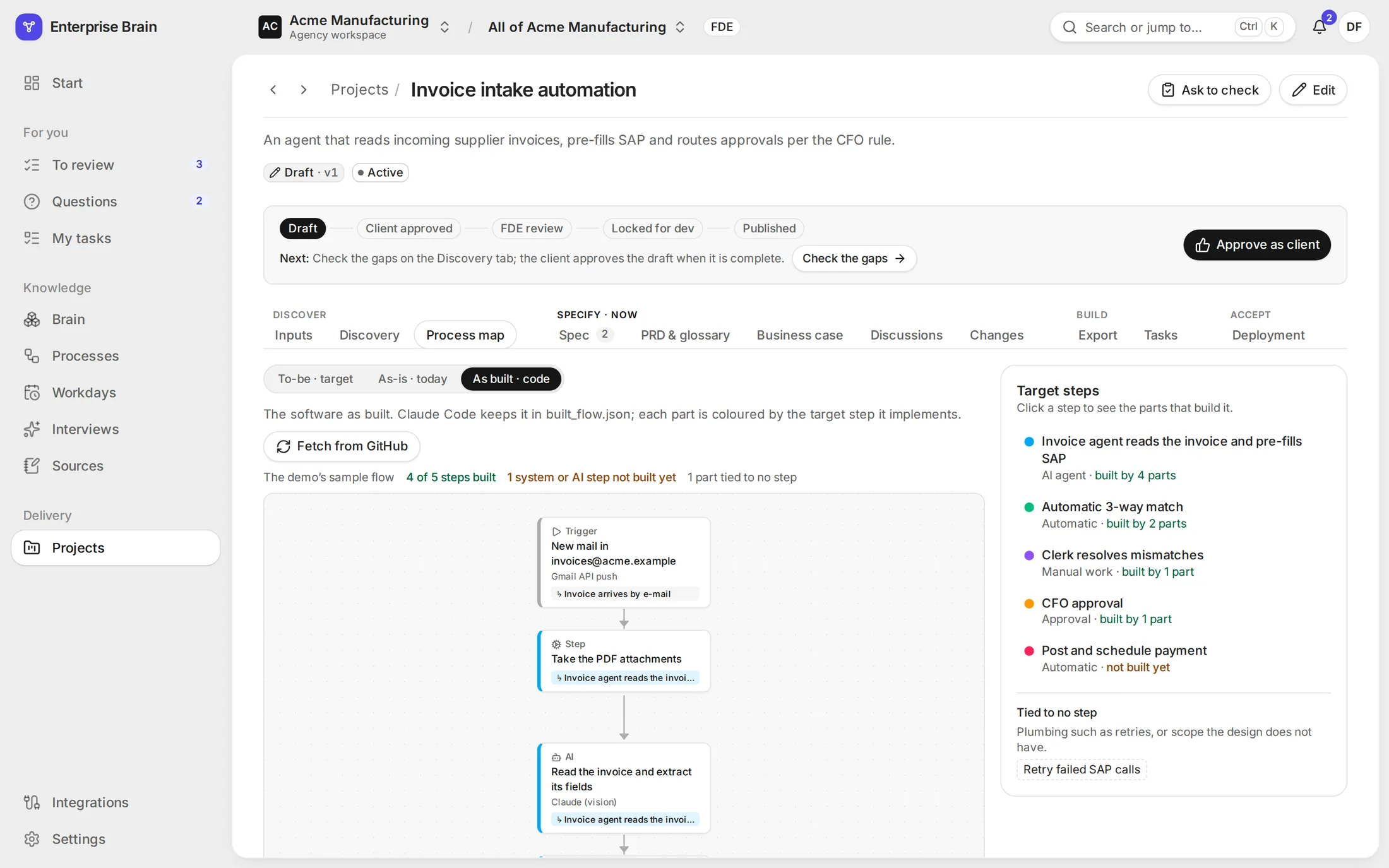
The invoice intake project's process map, as built: the parts of the software as a flow, each tied to the target step it implements, with 4 of 5 steps built and the posting step not built yet.
As built: the software Claude Code reports, step by step against the target. In the demo, 4 of 5 steps are built.

Accepted by the people who asked for it.

The client tests the running app next to its checklist. Benefits with a target become measured items, and the result is written back to the Brain.

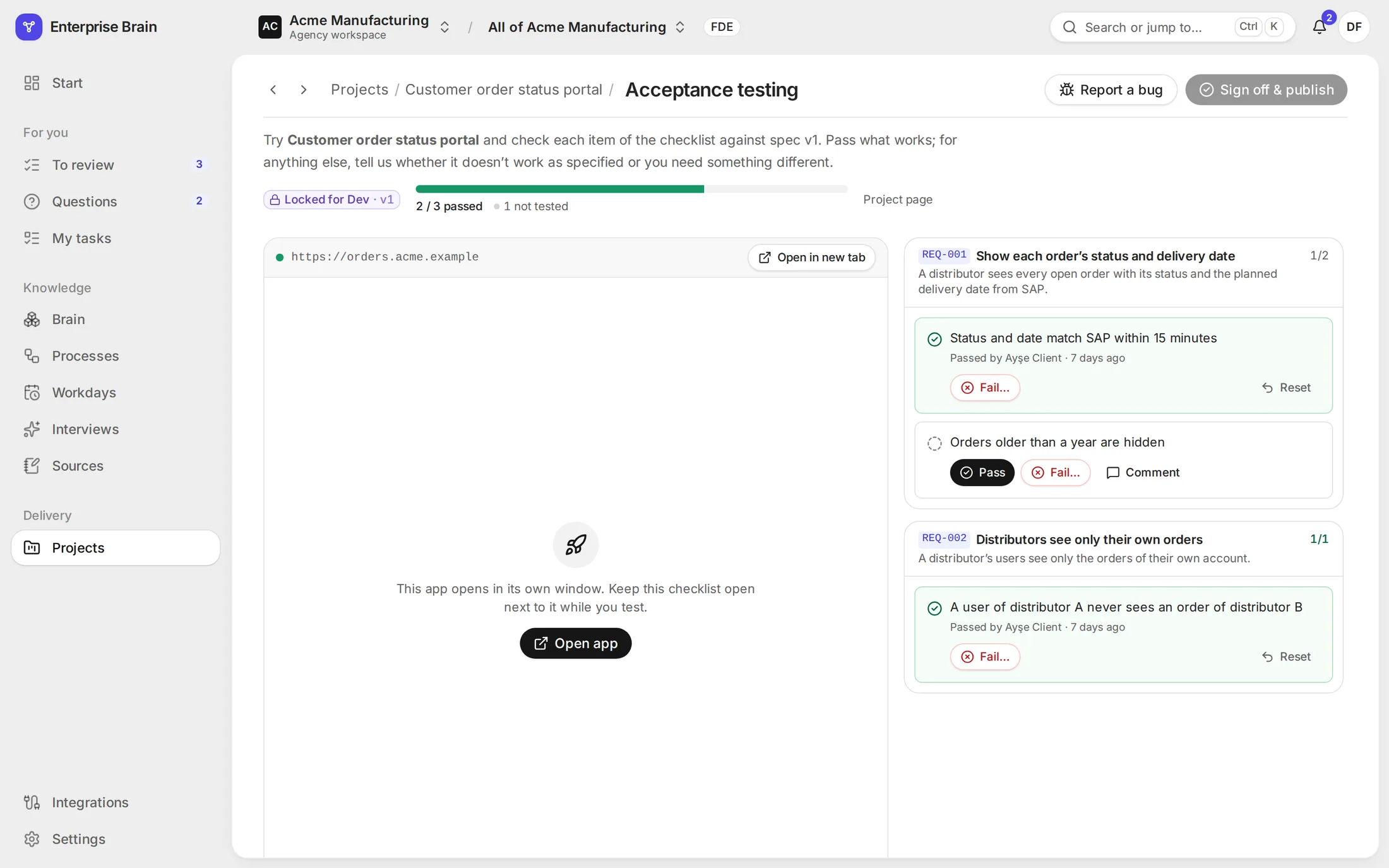
Acceptance testing of the Acme demo's customer order status portal: the app next to its checklist per requirement, 2 of 3 items passed and one waiting.
Acceptance testing: pass what works, report what doesn’t. A failed item becomes a request for the next version.

From first conversation to work in motion.

How an engagement runs, and what Enterprise Brain does at each step.

  1. 1

    First conversation

    A thirty-minute discovery call about where AI should help first.

    A workspace for the company; the strategy interview sets the direction.

  2. 2

    Deep dive with the experts

    Agree on the problem, today’s baseline and the outcome that counts.

    The business interview captures how the work runs today, with its numbers.

  3. 3

    Map the workflows

    Steps, decisions, data and who is responsible for what.

    As-is and to-be maps; the platform computes hours, FTE, cost and lead time.

  4. 4

    Review with domain experts

    Challenge the rules and edge cases; agree on acceptance criteria.

    The review queue, discussions on each requirement, the spec locked for development.

  5. 5

    Build agents and automations

    Engineers build and test against realistic cases.

    The context package and the MCP server for Claude Code; evaluation sets with targets.

  6. 6

    Deploy and work together

    Connect the systems; the owner signs off.

    The acceptance portal: the app next to its checklist, with measured results.

  7. 7

    Improve, reuse and scale

    Review the outcomes and carry what works to the next process.

    Requests and update packages; the Brain keeps what each project learned.

Two ways to run it.

The same platform and the same model of a company, delivered by our team or run by yours.

With Infinics

In use now
  • One instance; every client gets a workspace of its own, isolated from the others.
  • The AI Analyst interviews the client’s people and builds the client’s Brain.
  • A forward-deployed engineer reviews the spec and hands the package to the build team.
  • The client accepts the finished app or agent in the platform.

On your own

Next
  • A company runs its own instance: one workspace, or one per division.
  • The Brain becomes a living model of the organisation that every agent plugs into.
  • Employees describe their processes and workdays; nobody needs a project to start.
  • A Brain Steward confirms what is learned and keeps it current.

Built for trust. Ready for the enterprise.

What the platform does today, and where it goes next.

Built in

Today
  • Each client’s knowledge lives in its own workspace; nothing crosses between them.
  • No password or key ever enters the Brain, a prompt or a package: only its name.
  • The AI proposes and a person confirms. Every record keeps its source and its history.
  • The software that is built reads the Brain through read-only keys.

Where we’re going

Roadmap
  • Enterprise controlsIdentity and access, data and privacy, models and budgets, policies and approvals, quality and releases, operations and audit.
  • A skill libraryExpertise validated on one project, reused on the next, with each client’s data and rules kept apart.
  • Expert routingDomain experts brought into the work where their judgement is needed.
  • Evaluation runs and capture in the browserAgents tested against their evaluation sets; work captured where it happens.

Expertise that grows.Software that scales.

Book a demo

Built by Infinics, in use on our first client projects.